
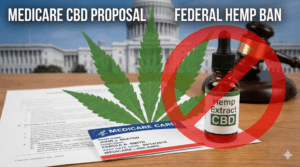
The cannabis industry faces another regulatory paradox. The Centers for Medicare & Medicaid Services (CMS) has proposed allowing Medicare Advantage plans to cover hemp-derived CBD products starting in 2027, potentially opening insurance reimbursement for millions of seniors. Yet this potential coverage window arrives just as a separate federal law threatens to make many of those same products illegal.
For CBD and hemp business owners, this contradiction creates both opportunity and uncertainty. Understanding these conflicting policies is essential for planning your next moves in an industry where regulatory clarity remains elusive.
The Medicare Proposal: A Policy Reversal
In a significant shift, CMS announced it would amend Medicare regulations to prohibit coverage only for
“Cannabis products that are illegal under applicable state or federal law.”
This reverses their April 2026 final rule that explicitly excluded all cannabis products from coverage.
The proposed change, detailed in MJBizDaily reporting, would specifically allow coverage for hemp seed oil, hemp seed protein powder, and hulled hemp seeds. While not covering CBD extracts directly, it represents the first crack in federal insurance barriers for hemp products.
Industry advocates like Howard Kessler, whose Commonwealth Project produced a video promoted by former President Trump, have pushed for this change. Their argument centers on potential healthcare cost savings and improved senior access to alternative treatments.
The Federal Hemp Ban: An Existential Threat
Simultaneously, legislation signed in November 2025 redefines hemp under federal law. The new rules, which take effect November 13, 2026, prohibit “any intermediate hemp-derived cannabinoid products containing more than 0.3% combined total of total tetrahydrocannabinols” and impose a strict 0.4mg THC per container limit.
This creates a fundamental problem: during extraction and refinement, almost all CBD crude and distillate routinely exceed 0.3% total THC on a weight basis, even when final products test below the limit. Under the new definition, these intermediate materials become controlled substances, potentially making legal CBD production impossible under current methods.
CMS acknowledged this contradiction in their proposal, noting that hemp products meeting the current 2018 definition remain legal “through November 11th, 2026,” with those meeting the amended definition remaining legal thereafter.
What This Means for Your Business
For CBD manufacturers and retailers, the timeline creates a precarious situation. You might gain insurance coverage for your products in 2027, but face production and distribution challenges starting in late 2026. This regulatory whiplash demands careful strategic planning.
First, review your product formulations and supply chains. Can your current products meet the 0.4mg THC per container limit? If not, what reformulation or sourcing changes will be necessary?
Second, consider your market positioning. Medicare coverage could open the senior demographic significantly, but only if your products remain legally viable. This creates both risk and opportunity for forward-thinking businesses.
Third, monitor state-level responses. Some states may adjust their hemp regulations to align with federal changes, while others might maintain more permissive frameworks. Your hemp product listings should reflect these jurisdictional differences.
SEO and Visibility in a Shifting Regulatory Landscape
When regulations change this rapidly, online visibility becomes your most valuable asset. Businesses that establish authority through consistent, informative content capture market attention during transitional periods.
Consider these strategies:
- Educational Content: Create resources explaining the Medicare proposal and hemp ban implications. Position your business as a knowledgeable guide through complex regulations.
- Local SEO Optimization: As state responses vary, ensure your business directory listings accurately reflect your compliance status and service areas.
- Backlink Building: Quality do-follow links from authoritative sources signal credibility to both search engines and potential insurance partners. A verified CannaMapr listing provides this authority while connecting you with patients and customers navigating these changes.
The regulatory contradiction between potential Medicare coverage and impending hemp restrictions highlights why fragmented cannabis policies create business uncertainty. Yet within that uncertainty lies opportunity for prepared operators.
Looking Ahead
Patient advocate Sasha Kalcheff-Korn, executive director of Realm of Caring, welcomed the Medicare policy but warned: “Without a clear federal regulatory pathway for these products within the next 11 months, millions of Americans who rely on them could lose access.”
Similarly, Jasmine Johnson, CEO of GūD Essence, noted that the ban
“Destabilises an entire sector that has generated jobs, tax revenue, and safe access for millions of Americans”
All while pushing consumers toward unregulated markets.
For now, CBD and hemp businesses should prepare for both possibilities: expanded insurance coverage starting in 2027, and significant regulatory changes in late 2026. Those who adapt their operations while maintaining strong online presences will be best positioned regardless of which outcome dominates.
CannaMapr is here to help you navigate these regulatory shifts and maintain visibility during uncertain times. With a trusted network and real-time updates, we make it easier to connect with quality providers and grow your online presence.